


By Mia Nakaji Monnier and Nao Nakanishi
Rafu Staff Writers
日本語の記事(1)はこちらをクリック
日本語の記事(2)はこちらをクリック
Each July during Obon, Japanese Americans gather in the Nishi Hongwanji Temple gym to buy udon. Under the basketball hoops, they slurp noodles out of Styrofoam bowls before wandering back into the cooling night to dance Obon odori, pacing ovals in the parking lot, waving uchiwa, those round paper fans with the plastic skeletons that you can find, any time of year, in Japanese American houses and in the pockets of car doors.
Thursday night, around 400 people packed into the temple gym, mostly elderly, mostly wearing red—red shirts, red scarves, red hachimaki tied, warlike, around foreheads. The crowd filled the chairs and spilled out into the back and wings of the gym, holding signs and uchiwa—not used for dancing now, but for protest. In red marker, in all capital letters, they said, “SAVE KEIRO.”
Many in the Japanese American community, led by a protest group, the Ad Hoc Committee to Save Keiro, had been demanding an open meeting like this one for weeks, and Keiro Senior HealthCare had finally obliged. Even after the meeting started, people continued to come in through the gym doors, and the audience strained to hear the speakers over the squeaks and bangs of folding chairs being wheeled out on metal trollies across the wooden floor.
—
Keiro Senior HealthCare first announced its intention to sell its facilities—two nursing homes, a retirement home, and an intermediate care facility (ICF)—in early 2014. Because Keiro is a nonprofit, before any sale could go through, California State Attorney General Kamala Harris would have to find it “in the community’s best interest.” In fact, when Keiro found its first potential buyer, Ensign Group in fall of 2014, Harris vetoed that sale. Keiro continued its search for a buyer, eventually finding San Diego-based real-estate developer Pacifica Companies, and on September 2, they received a conditional approval from Harris.
The approval came with twelve conditions altogether, the overall gist of which was that Pacifica must keep operations (including Japanese-focused care and acceptance of Medicare and Medi-Cal) the same for the next five years. Rent costs would be frozen for one year. These concrete conditions, and especially their time limits, brought more of a sense of urgency to the pending sale. Keiro residents, doctors, and other concerned citizens wanted to know what would happen at the end of the one- and five-year conditional periods. Would rents become prohibitively high? Would Medicare and Medi-Cal patients (which make up around 66% of Keiro’s nursing home and ICF population) be asked to pay market rates or leave? Would the Japanese-tailored care disappear—not only the NHK programming and the comfort food, but also the Japanese-speaking staff and volunteers?
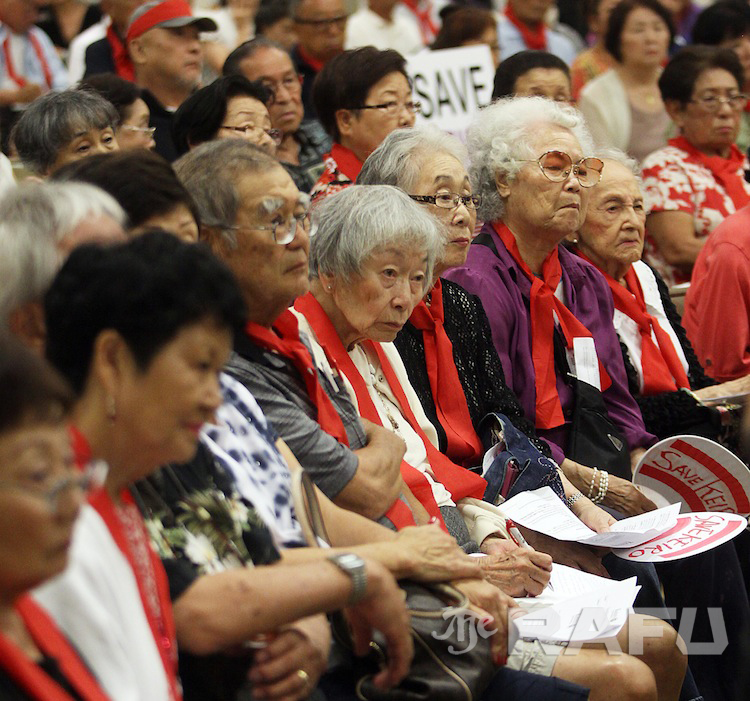
The Ad Hoc Committee had hoped it would be able to share control of the meeting with Keiro, but Keiro was adamant about sticking to its established process. Audience members were asked to write any questions on slips of paper in advance and wait until the panel had finished its presentation before they were allowed to speak. At a meeting scheduled to run from 6 to 8 p.m., Keiro, Aspen, and Pacifica representatives spoke until past 7, plus responses to audience questions.

As Miyake spoke, Erickson escorted elderly audience members to the few available chairs. One of them was Frank Omatsu, the last living founder of Keiro, now in his nineties and using a cane to support his tall frame. Erickson brought Omatsu to the front row, where they paused in the aisle as people moved to make space for him.
“That’s fine, thank you very much for your opinion,” said Miyake, and later, “A little maturity, please.”
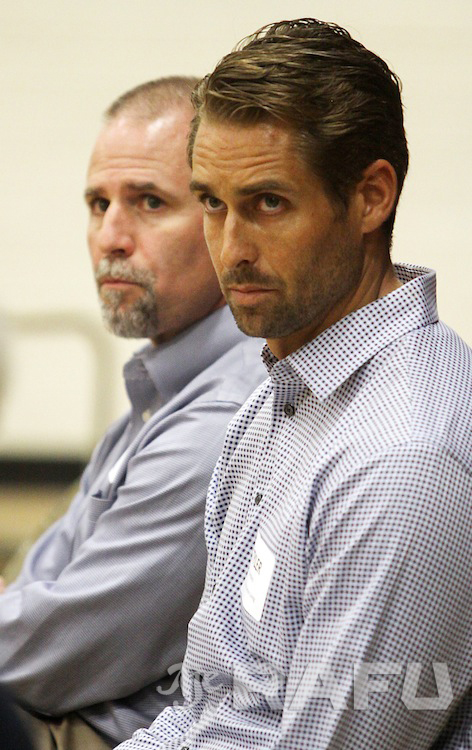
Aspen and Pacifica representatives spoke next. “What’s important for us is that the transition goes as smoothly as possible for residents, family members, and your wonderful volunteers,” said Verdieck of Pacifica, who looked to be about half the age of most audience members, with striped socks sticking out of patent leather loafers, and pronounced Keiro “kero,” like the cry of a Japanese frog. “We’re here to listen to what’s important to you.” Verdieck received the first applause of the night, not entirely enthusiastic but polite.

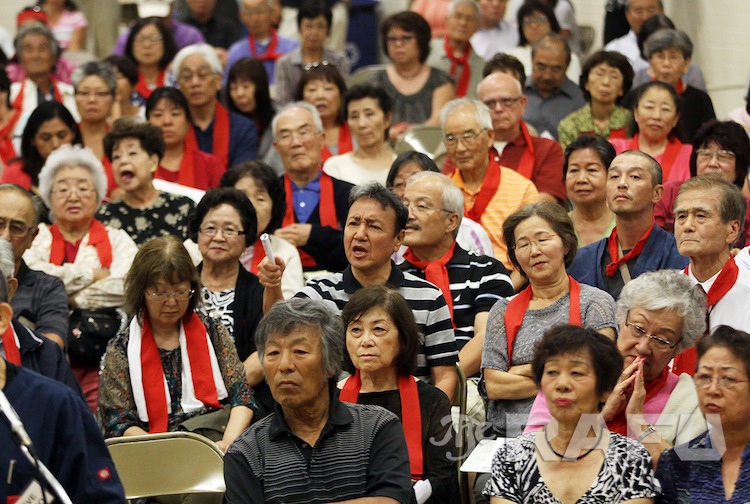

Around 8:10 p.m., Kawaguchi began to make closing comments. Though he came with prepared comments, he left them in his pocket, saying, “After hearing what you all had to say, I thought I should speak from the heart.” He emphasized that the board, not Miyake, takes full responsibility for the decision to sell. “Never would I do anything to damage the Japanese community,” he said. The crowd grew restless. A Japanese voice began to shout, “That’s enough! We don’t want to hear your story anymore!”
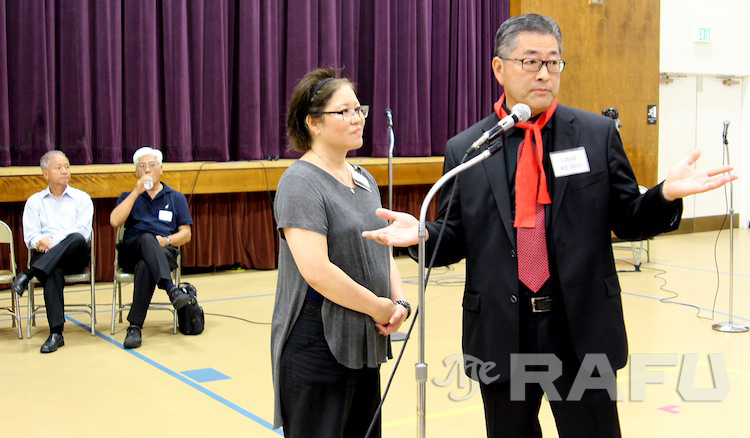
“I just need five minutes,” said Kaji. “What is five minutes?” For a moment, they stared at each other, in a silent stand-off. Finally, she walked away, leaving the microphone to him. “If we can’t come to a decision,” he said at the end of an eight-minute speech, “this group will take whatever means necessary — legal means, administrative means — to stop this sale.”
There is an online petition that Jonathan Kaji has started. You can sign it at: https://www.change.org/p/california-attorney-general-kamala-harris-keiro-board-of-directors-save-keiro-retirement-home
You can also send the link to concerned friends and family.
Vote with your dollars. Gary Kawaguchi and family are the owners of Upper Crust Enterprises, Inc. They are the makers of Panko Bread Crumbs and Tempura Batter mix. If you support their decision, buy their products. Otherwise boycott them.
Correction: The Japanese government contributed in 1987.
The Whittier earthquake of 1987 caused extensive damage to the living quarters of the Retirement Home, although no one was hurt. The board estimated it needed $7 million to completely rebuild the retirement home, and another fund drive brought in $3.5 million from local supporters and a matching $3.5 million from Japan. Keiro also benefitted from an unexpected exchange rate windfall; by leaving the Japanese donations in a Tokyo bank while the initial stages of reconstruction began, recalls Mitsumori, the funds grew along with the worth of the yen, resulting in an increase in value from $3.5 to $4 million. When the board learned this, recalls Mitsumori, “We immediately had the money transferred to Los Angeles.”
http://www.nancymatsumoto.com/article.php?id=69
After WWII there were many injustices faced by Japanese-Americans, and an attorney named Wayne M. Collins came to their rescue.
Is there someone like him now who can come to our rescue?
Gene Uzawa Dorio, M.D.
Santa Clarita, CA
My grandmother and aunt stayed at Keiro and they received the best of care. It’s important to have the Japanese community extend into this care facility in order for cared to be at ease and comfortable during their last years. Aging is not easy so therefore, any benefits Keiro is offering now (the same goes for Medicare and MediCal) should remain the same
Frank Kawana revealed the real reason Keiro is selling:
A former chair of the Keiro board, Frank Kawana, exhibited this divide clearly, when he was heard saying to a Nikkan San reporter after the meeting, “Keiro was founded for Issei and Nisei, not Shin-Issei, I’m sorry to say. They don’t participate in our community. They have no right to say, ‘You can’t do this, you can’t do that.’ They have no right.”
Mr. Kawana introduced me to a new level of discrimination. When the Japanese government contributed funds to start Keiro, did they place any restrictions on the ‘type’ of Japanese or Japanese-American that can be admitted? Considering the discrimination Mr. Kawana must have faced in his lifetime, the irony of his statement is palpable.
By the way, the Board says “all the information is on their website” but the 10/31/14 financial statements are not posted. I had to ask for a copy of the audit from their Resource Development Dept., and the financial statements look pretty strong. Needless to say, transparency is lacking…not to mention empathy.
What would an excellent piece of real estate be, basically, given away by Keiro Senior HealthCare board members? Odd, don’t you think? Why would the attorney general Harris allow the sale now when she had vetoed it in the fall of 2014? Odd again.. I guess greed is blind and has no borders…
I truly admire the Japanese community for fighting back and I am 100 percent behind them.